


One small bite for a fly, one giant itch for humankind
I almost never remember what I’ve done on any given day, but I can never forget what I was doing on July 20th, 1969. I was with friends and family on the shore of Lower Saranac Lake watching a static-filled black and white TV as Neil Armstrong and Buzz Aldrin walked on the moon.
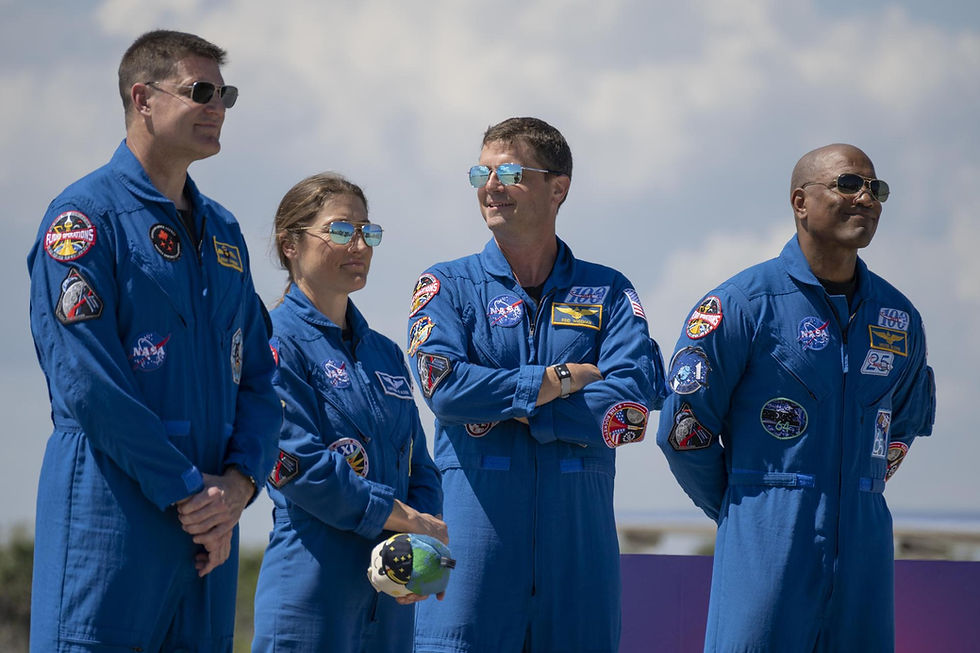
As space travel became more common it also became ho hum and taken for granted. But that all changed a few weeks ago. Space travel once again captured the imaginations of people around the world as four astronauts spent 10 days traveling deeper into space than ever before. The diversity of the Artemis II team might raise an eyebrow in circles suspicious of DEI‒‒after all there was a woman, a man of color, and most alarming of all, a Canadian. Working together under challenging and stressful conditions they operated with quiet efficiency and mutual trust that made any criticism of DEI moot.
Commander Reid Wiseman stated the crew, who lived together in the cramped capsule, "Launched as friends, returned as best friends."
And what do they attribute at least a portion of their success to? Their experience with the National Outdoor Leadership School (NOLS). That’s right, the same program that set me on my career path played an important role in the success of the Artemis II mission. Wiseman himself said that knowledge of expedition behavior played a key role in their success.
The founder of NOLS, Paul Petzoldt, described expedition behavior as “...being a nice, helpful person; doing your share of the work; dealing with conflicts when they occur. The goal of good expedition behavior is to work well together, not to necessarily become good friends” It’s as helpful on family vacations as it is in outer space.
The classic example of poor expedition behavior is the 1971 International Expedition up Everest. Thirty-two people from eleven countries speaking eight languages attempted the climb, along with four hundred porters and forty-two sherpas. It ended up a disaster with people hurling rocks and insults at each other, others abandoning the expedition, and even a death.
Because I spent my entire career teaching expedition behavior, finding out its value to astronauts is deeply gratifying. Still, I wonder whether, under slightly different circumstances, I might have made a bigger contribution to astronaut training if it hadn’t been for the curse of the Adirondacks…black flies.
Houston, we have a problem
In the early 1990s I was president of the Wilderness Education Association (WEA) which had moved from western Illinois to the NCCC campus. The WEA ran numerous courses here, one of which was taught by my colleague Maurice Phipps, of Western Carolina University. Furthermore, Cheryl Irwin, a researcher at the NASA-Ames Research Center, was a participant.
I played host, greeting participants as they arrived and got outfitted for their trip. I remember feeling a particular spark of curiosity when I learned someone from NASA had joined the course—there was something almost surreal about NASA and WEA partnering here in the Adirondacks.
I didn’t accompany the group into the field, but ten days later I welcomed them back. They emerged weathered but excited about their new-found skills and knowledge. They were buzzing about their Adirondack experience. I have a vivid memory of Cheryl: her face and neck covered with angry red welts, the aftermath of innumerable black fly bites. Just looking at her made me itch. She carried herself with quiet dignity, brushing it off with a shrug and a half-smile, as if discomfort was just another part of the experience to be absorbed and endured.
Fast forward a decade. NOLS had started training astronauts in Wyoming, not here. When I learned that I couldn’t help but wonder if somehow, I’d dropped the ball. It had to do with Cheryl. Maybe I’d read the situation wrong. Maybe the bugs had bothered her way more than she let on. Maybe I should have been more compassionate. Locals like to think of black flies as a short-lived spring nuisance—but what if those tiny vampires were actually deal-breakers? And the deal that got broken was astronaut training right here at NCCC.
Did the experience sour her on the region entirely? Was it less “great wilderness” and more “bug haven"?
So, I keep asking myself: did those tiny, fiend insects tip the scales with a thousand itchy, well-placed bites, and push astronaut training westward, one welt at a time?
(L) Me on my NOLS course 1970 (R) Me teaching at NCCC 1987


History turned by the cuts of a million mandibles? Deb and I get five of the buggers buzzing our garden and we head inside... clearly not made of the "right stuff". Once again a wonderfully entertaining tale, Jack. Kelty Expedition frame packs and all that wool...what a flashback photo!