


A scarf full of stories
Updated: Apr 23
Bushwhack Jack’s Tracts has reached a milestone. And while my English teachers are rolling over in their graves – I’m providing you with my 100th column!
I thought I had some decent stories to tell but telling them in a way that people want to read them has been the challenge. If you enjoy my storytelling most of the credit is due to Bob, Mr. InSeide Dope, Seidenstein. Without his encouragement and help, these stories would have remained locked in my mind… perhaps where they belong.
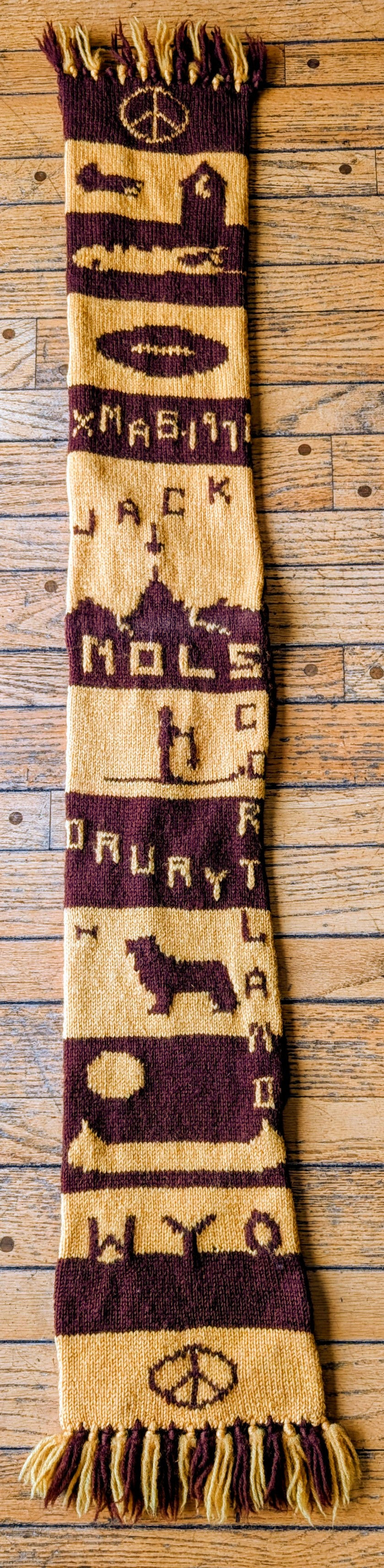
An appropriate 100th column came to mind recently when trying to get rid of some old clothes. One item I should have thrown away ages ago but just couldn’t part with was my high school letter sweater. I

received it the last week of high school and only got to wear it once or twice before I graduated. It’s been hanging in my closet ever since. I haven’t worn it in 60 years and will never wear it again, but throw it away? Never. It was too hard earned, because it took four years of effort and sweat. How could I throw it away?
When I picked up the hanger, I felt something under the sweater. When I took the sweater off the hanger underneath was a scarf.
Our lives are recorded in different ways, photo albums that crackle when opened, and flickering old home movies with no sound. But there are additional archives, too. Needlepoint comes to mind, each stitch pulled tight with patience; a patchwork quilt, each square telling a story. And there was my scarf. My mother had knitted it around 1972, thick with the earthy brown and gold colors of the University of Wyoming. The wool softened with time, and when I gathered it up, it was as if I could feel the intimacy she put into it.

As I showed it to Phyliss, describing each section, I realized I’d written over twenty columns about the various knitted scenes. In fact, there was only one I hadn’t written about — Christmas 1970. My dad passed away in December of 1966 after a long illness. I still wonder how my mother carried it all — tending to my father, keeping the family business alive, and caring for the rest of us. But four years later for Christmas of 1970 my mother thought our family should make a pilgrimage to San Francisco to spend the holiday with my father’s mother.

My grandmother was an aristocratic lady and lived in the Nob Hill luxury Brocklebank apartments at 1000 Mason Street. You have probably have never been there, but you may well have seen them. If there’s a movie that takes place in San Francisco, the Brocklebank apartments are frequently featured. TV show The Streets of San Francisco, and Hollywood films Impact, Bullit, Dirty Harry, Magnum Force, Tales of the City, The Lady in Red, and most famously, Alfred Hitchcock’s Vertigo all have scenes with the Brocklebank. I can only imagine what it costs to live there, but in 1970 my mother, sister’s and good friend Lyle Dixon, flew out and spent the holiday with my grandmother.
We had formal dinners at her apartment (including fingerbowls), she took us to her favorite restaurant, Trader Vic’s, we hobnobbed with her military friends (My step grandfather was a major general and is buried at Arlington Cemetery), and Lyle and I got to attend a classic UCLA basketball game.
UCLA defeated Princeton 76-75 behind a Sidney Wicks basket with three seconds remaining. UCLA, with John Wooden as coach, finished the season with a 28-2 record and went on to win their sixth national championship in seven years. It was a memorable experience for a young sports enthusiast college student.
It was a special Christmas with family and friends, but looking back fifty-five years later, I’m struck by my mother’s determination to take our family across the country to visit her mother-in-law. It reveals a great deal about who she was and her relationship with my grandmother.
In-law relationships are formed not by choice or shared history, but by connection through someone both sides love. As a child I saw my mother’s relationship with my dad’s mom as initially more than cordial but less than loving. It evolved over time, however. I think my grandmother came to appreciate my mother and all she did to care for my father, especially when he became ill. She also recognized what a great mother she was to her children. My mother, on the other hand, came to appreciate my grandmother and how much she loved and supported her grandchildren: My brother, sisters, and I all had a great relationship with my grandmother and benefited with visits to her in San Francisco and travels with her to far flung places.
When it’s all said and done my brother, sisters and I were fortunate to have my mother and grandmother. They were two grand ladies.


That needle point is amazing, as was your mother's ability to handle what life threw her way. The sweater and scarf are keepers! Congratulations on your 100th column!
Happy to see that one of the other commenters also needed tissues after reading this post. Always nice to not feel alone. That was a good one, Jack! And someone who also lost their mom I love hearing other people's memories of theirs. As always, thanks for sharing.
Impressed that the jacket still fits!
Boy does this blog bring back memories. That was a great trip. Probably the first and last time I ever used a finger bowl. lol I hope that you are surviving better in the North county than we are on Seneca Lake. the lake level is so high and with strong south winds, many people have lost docks, boat hoists, and destroyed a lot of property. Hopefully they can let some water out soon to lower the lake level.
A delightful peek at our past!
With fondest memories!♥️