


No Runway? No Problem!
Don Sheldon was a renowned bush pilot and the man who made the airdrop for our Denali expedition in 1971. He operated with his company Talkeetna Air Service from the 1950s until his death in 1975. He was a man who had the greatest impact on people climbing Denali. Phyliss and I got to visit his hometown on our recent trip. Although it's now more a tourist community than an aerial hub, the grass runway and his hanger still memorialize his work.
Don Sheldon's hanger and airfield
The simplest route up Denali is the West Buttress which, with good weather and a little luck, allows climbers to summit in less than three weeks. Sheldon helped establish the route by proving planes could safely land and take off from the Kahiltna Glacier at 7,200 feet, making the mountain far more accessible to climbers. Sheldon helped develop and modify aircraft skis using a combination wheel-skis that allowed him to take off from gravel runways in Talkeetna and land seamlessly on the high-altitude snowfields.
Although our group took the much longer Muldrow Glacier route, Sheldon was instrumental in getting our food and equipment up the mountain. The Muldrow route, located on the opposite side of the mountain from the West Buttress, is the route the mountain was first climbed in 1913. It requires a commitment of forty days, and starts at Wonder Lake, 2,000 feet above sea level.

Horse packers helped us haul gear 14 miles up to the glacier. But it was Sheldon who made the series of airdrops at our camp at 10,000 feet that saved us from hauling 5,000 pounds of food and cold-weather gear all the way from our starting point. Airdrops are no longer allowed within the Park and due to a glacial surge in 2021, where the Muldrow Glacier moved up to 100 times faster than normal creating a labyrinth of crevasses, this route is now rarely used.
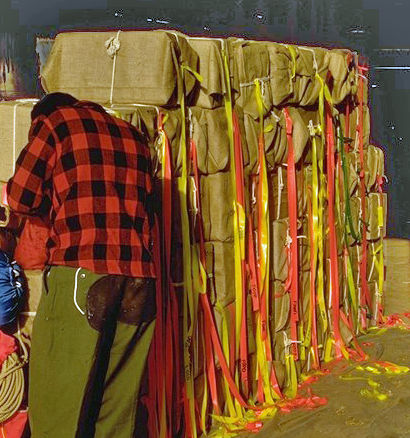
Nearly a month before the airdrop we were in Anchorage packing all our food and gear following Sheldon’s detailed instructions. We put ten-days worth of rations per person (25 pounds) in nylon bags, put the bags in double-walled cardboard boxes of the exact dimensions dictated by Sheldon, wrapped them in burlap, and attached six feet of bright orange and yellow surveyors tape on each end of the boxes. We then loaded the boxes along with our packs, snowshoes, climbing ropes and other gear onto the train. Once we arrived at the Park headquarters we unloaded the train and made a special pile for Sheldon before heading by bus to our starting point at Wonder Lake.

A week later we were at 9,000 feet, in the midst of the Great Icefall on the Muldrow Glacier. Because our camp was surrounded by crevasses we didn’t leave the camp's perimeter without being roped up. Sheldon flew over about fifty feet above us and dropped a package. As luck would have it, it dropped into a crevasse. Sheldon noticed and flew over again, this time dropping a smaller package. We retrieved it and in it was a can of Coca Cola which turned out to be ballast for the message: “Bad weather with high winds is expected within 48 hours. Please go up to the airdrop site and mark out where you want the airdrop because I want to make it early tomorrow.” We moved up the glacier 1,000 feet, set up camp, and awaited the airdrop.
Two contrasting airdrops - the left at about 50 ft - the right at over 100 ft
(note the food bag below the plane in the photoe on the right)
We were surprised when he flew over, not at the 50 feet he had the day before, but at over 100 feet above our campsite. And then to our even greater surprise, instead of being rained on by cardboard boxes, the nylon food bags themselves came dropping from the sky. This is because the day before, Sheldon had crashed his Cessna 185, the plane he planned to do the airdrop with. As with all of Sheldon’s half dozen or so crashes during his lifetime, he walked away with no more than a cut forehead and a black eye.
So when he flew over to drop our supplies, two things were different. One, there were downdrafts preventing him from flying as low as he normally would. And two, he had to use a smaller plane with a smaller window. So he pulled all the gear out of the cardboard boxes and dropped it from over 100 feet onto the glacier. Some food bags dropped into crevasses never to be retrieved. Others hit the snow and burst open. We joked that if we ran out of food we could scoop up gorp, minestrone soup mix, oatmeal, and spaghetti, throw it in a pot and call it “airdrop soup” (We never did). The process caused us to lose about ten percent of our food and we paid the price towards the end of the expedition when rations ran low.

By the way, remember that first package that fell into a crevasse and was never retrieved? We found out much later that it was a gallon of ice cream. Even though we had cold nights, the days were hot and we would have loved the treat. We learned that Sheldon usually provided a gift of either ice cream or beer to his expeditions, and frankly, I’d have gleefully devoured either one.
There’s an excellent biography of Don Sheldon by James Greiner titled “Wager with the Wind”


Great story about a great legend!